

From ancient ruins hidden beneath dense jungles to deserts that sing and seas that swallow ships, our planet is full of places that continue to puzzle scientists, historians, and adventurers. These mysterious locations blend natural wonders with unanswered questions, leaving us with theories—but rarely complete explanations.
Below are some of the most mysterious places on Earth and the leading ideas researchers have proposed to explain them.
⭐ 1. The Bermuda Triangle — The Ocean’s Most Famous Mystery
For decades, the Bermuda Triangle—stretching between Miami, Bermuda, and Puerto Rico—has been linked to unexplained ship and aircraft disappearances. Stories of compass malfunctions and ships vanishing without distress calls have fueled global fascination.
What Researchers Believe
Scientists say unusual weather patterns, rogue waves, and strong ocean currents can easily overwhelm ships. Others point to methane gas eruptions from the ocean floor that may reduce water density, causing ships to sink rapidly. While many incidents have been scientifically explained, the region’s unpredictable weather still keeps the legend alive.
⭐ 2. The Nazca Lines, Peru — Giant Symbols Carved Into the Earth
Etched into the desert floor over 2,000 years ago, the Nazca Lines form enormous shapes like spiders, monkeys, birds, and strange geometric patterns visible only from the sky. How and why these massive drawings were created remains a mystery.
What Researchers Believe
The most accepted theories suggest they were used for religious ceremonies or astronomical calendars. Some lines align with star positions and solstice events. Still, their enormous scale raises questions about the Nazca people’s methods and purpose.
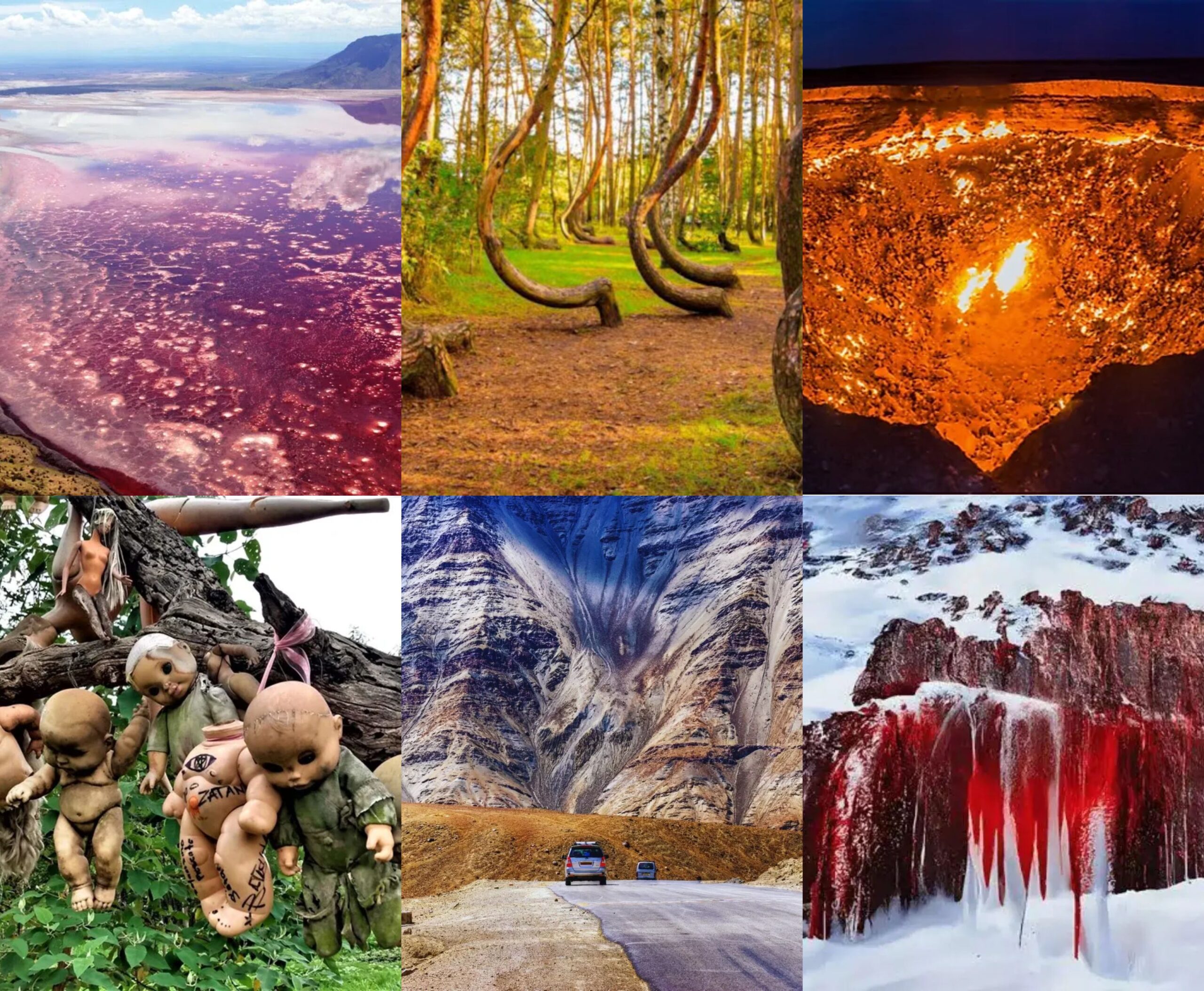
⭐ 3. The Door to Hell, Turkmenistan — A Fiery Crater Burning for Decades
In the Karakum Desert lies a massive flaming crater known as the “Door to Hell.” The pit has been burning continuously since 1971, casting an eerie orange glow over the barren landscape.
What Researchers Believe
Scientists explain that it began when Soviet geologists accidentally collapsed an underground gas cavern while drilling. To prevent toxic gas leaks, they ignited the gas—expecting it to burn out in a few days. Instead, it has been burning for more than 50 years due to constant natural gas replenishment beneath the crater.
⭐ 4. Aokigahara Forest, Japan — The Eerie ‘Sea of Trees’
Located at the base of Mount Fuji, Aokigahara is known for its dense vegetation, unnatural silence, and reputation for people going missing. Compasses often behave strangely, adding to the unsettling atmosphere.
What Researchers Believe
The magnetic anomalies come from volcanic deposits beneath the forest floor, which can interfere with navigation tools. The forest’s deep silence is due to acoustic insulation from thick trees and lava caves. While the supernatural reputation persists, researchers emphasize that its eerie nature comes largely from geology and isolation.
⭐ 5. The Pyramids of Giza, Egypt — Engineering Far Beyond Their Time
The Great Pyramids have fascinated the world for centuries. Their perfect alignment with cardinal points, precise measurements, and massive stone blocks raise endless questions about how ancient builders achieved such accuracy without modern tools.
What Researchers Believe
Archaeologists explain that the construction involved advanced knowledge of mathematics, astronomy, and engineering. Ramps, rollers, and enormous labor forces likely played key roles. Still, some details—like the exact logistics of lifting multi-ton stones to extreme heights—remain debated.
⭐ 6. The Blood Falls, Antarctica — A River of Red Water in a Frozen World
In East Antarctica, bright red water bursts out from a glacier and flows over the ice, looking like blood pouring from the frozen landscape.
What Researchers Believe
Researchers discovered that the red color comes from iron-rich water trapped beneath the glacier for millions of years. When exposed to oxygen, the iron oxidizes—just like rust—turning the water red. The subglacial ecosystem contains microbes that survive without sunlight, raising fascinating possibilities about life in extreme environments.
⭐ 7. Lake Natron, Tanzania — A Lake That Turns Animals Into Statues
This eerie salt lake can “mummify” animals that fall into its waters, coating them with hardened minerals that preserve their bodies.
What Researchers Believe
The lake’s extreme alkalinity—due to high sodium carbonate levels—calcifies animals that die in the water. The lake also reflects intense sunlight, making the surface appear pink or red. The phenomenon is natural, but its haunting appearance makes it seem otherworldly.
Why These Mysteries Matter
Mysterious places like these remind us that Earth is far more complex than we realize. Even with modern science and advanced technology, some mysteries remain only partially understood. They challenge researchers, inspire explorers, and spark endless curiosity about our world’s hidden wonders.